
Fontana
Automation for financial processes

The governed operating layer for financial operations and AI.

Replace manual processes, spreadsheets, and disconnected systems with governed AI-driven workflows.
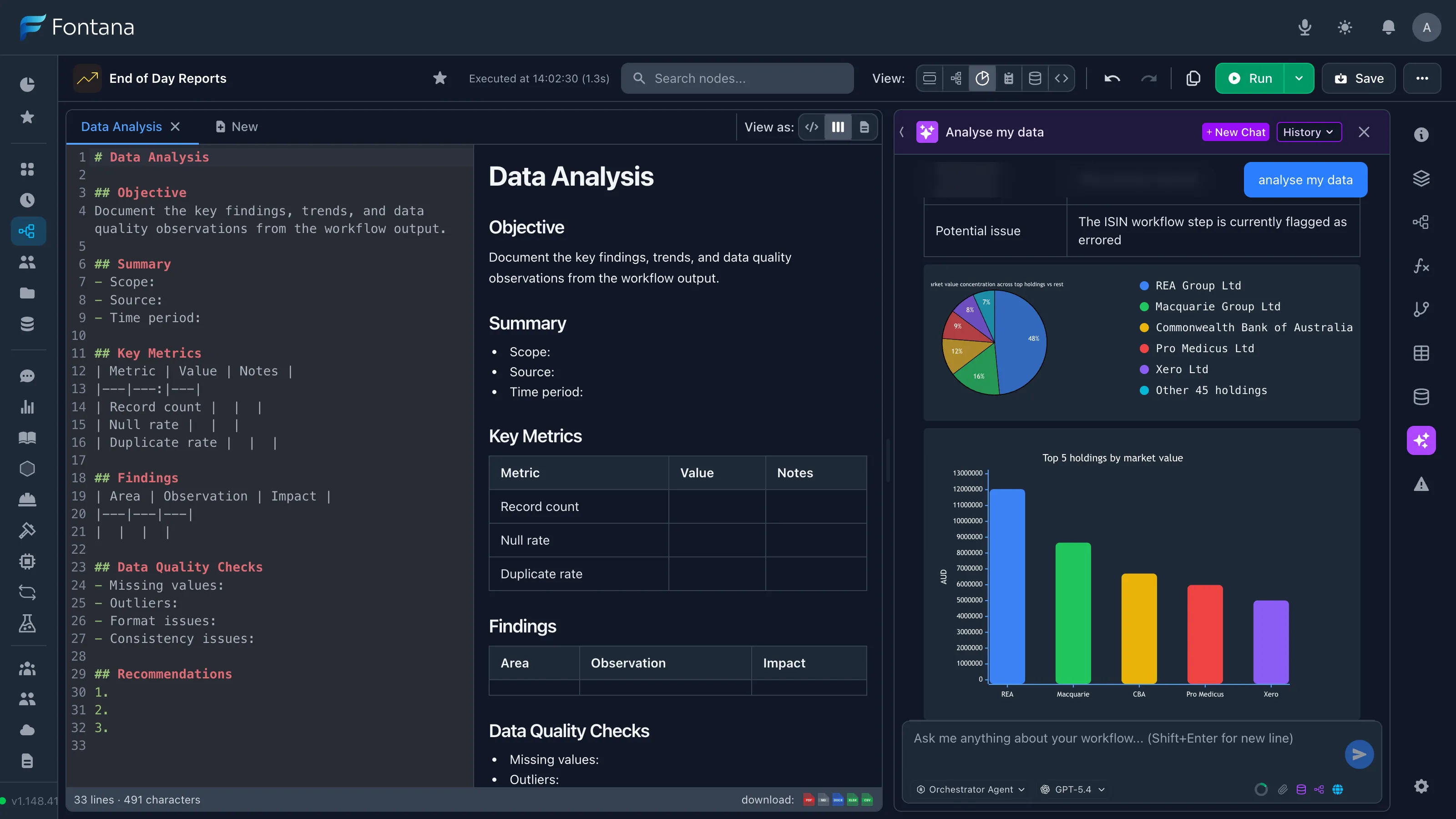
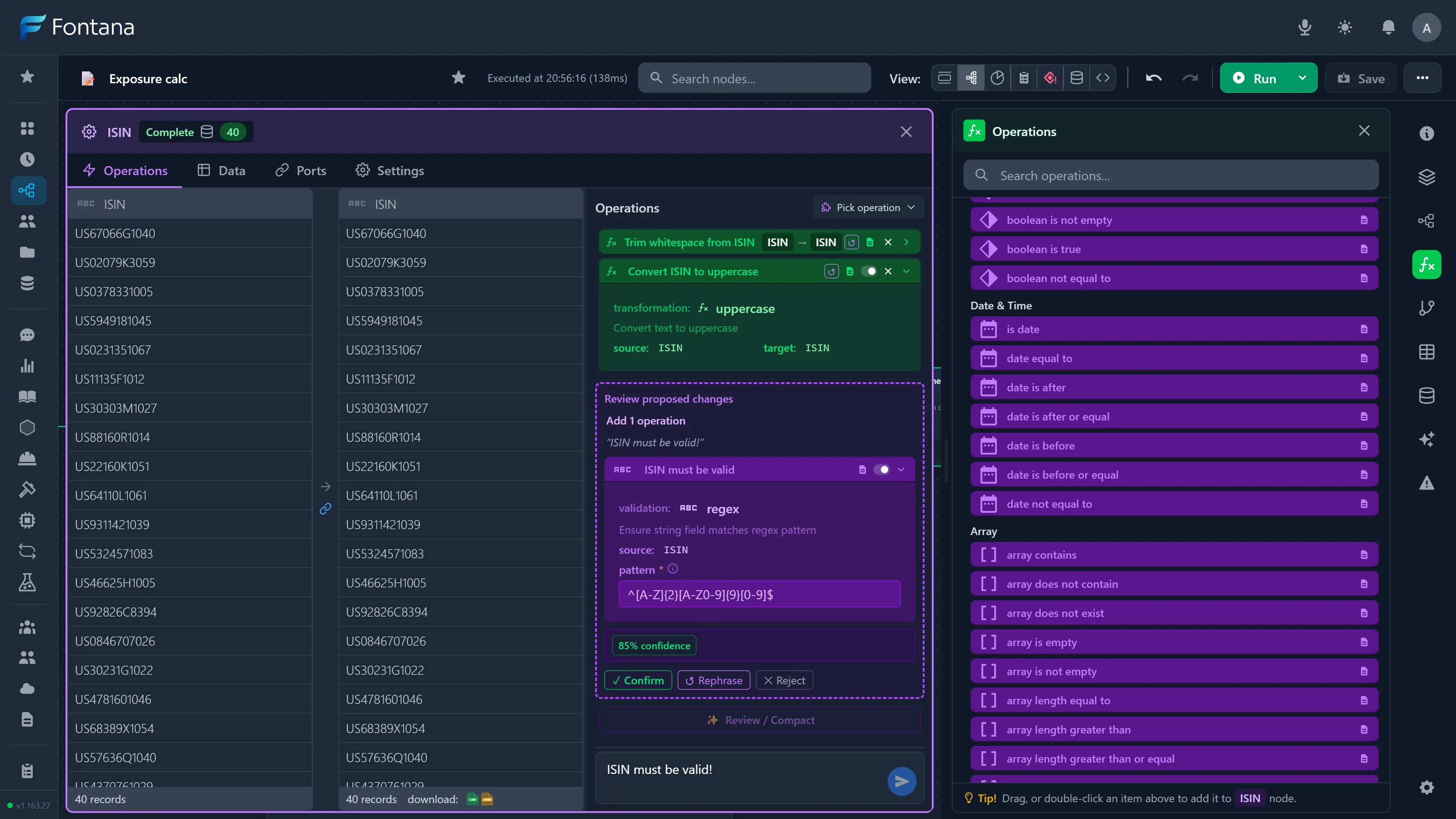
Fontana data analysis view with markdown report, metrics tables, and AI analysis charts
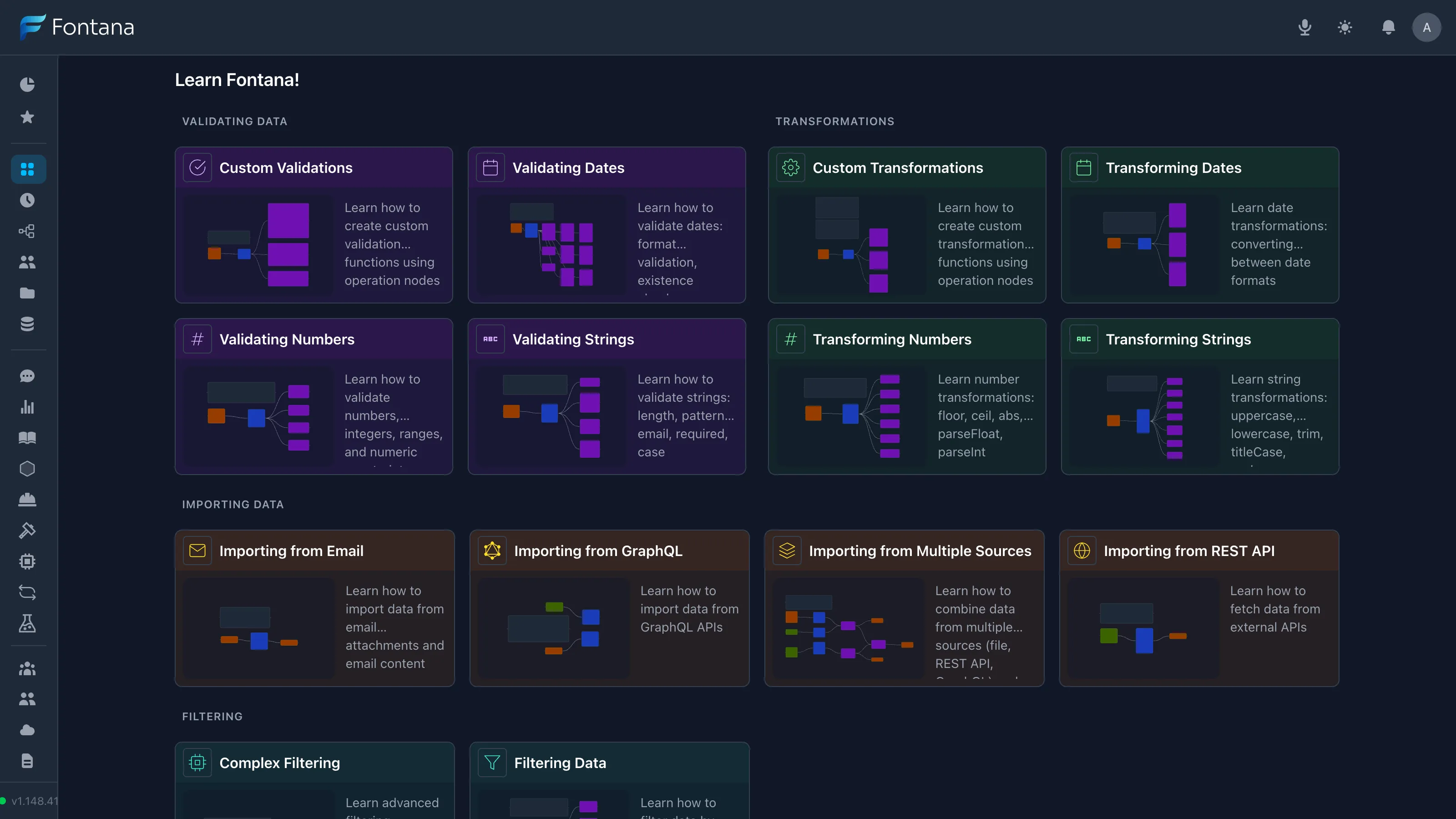
Fontana Learn dashboard with guided workflow examples for validation, transforms, and imports
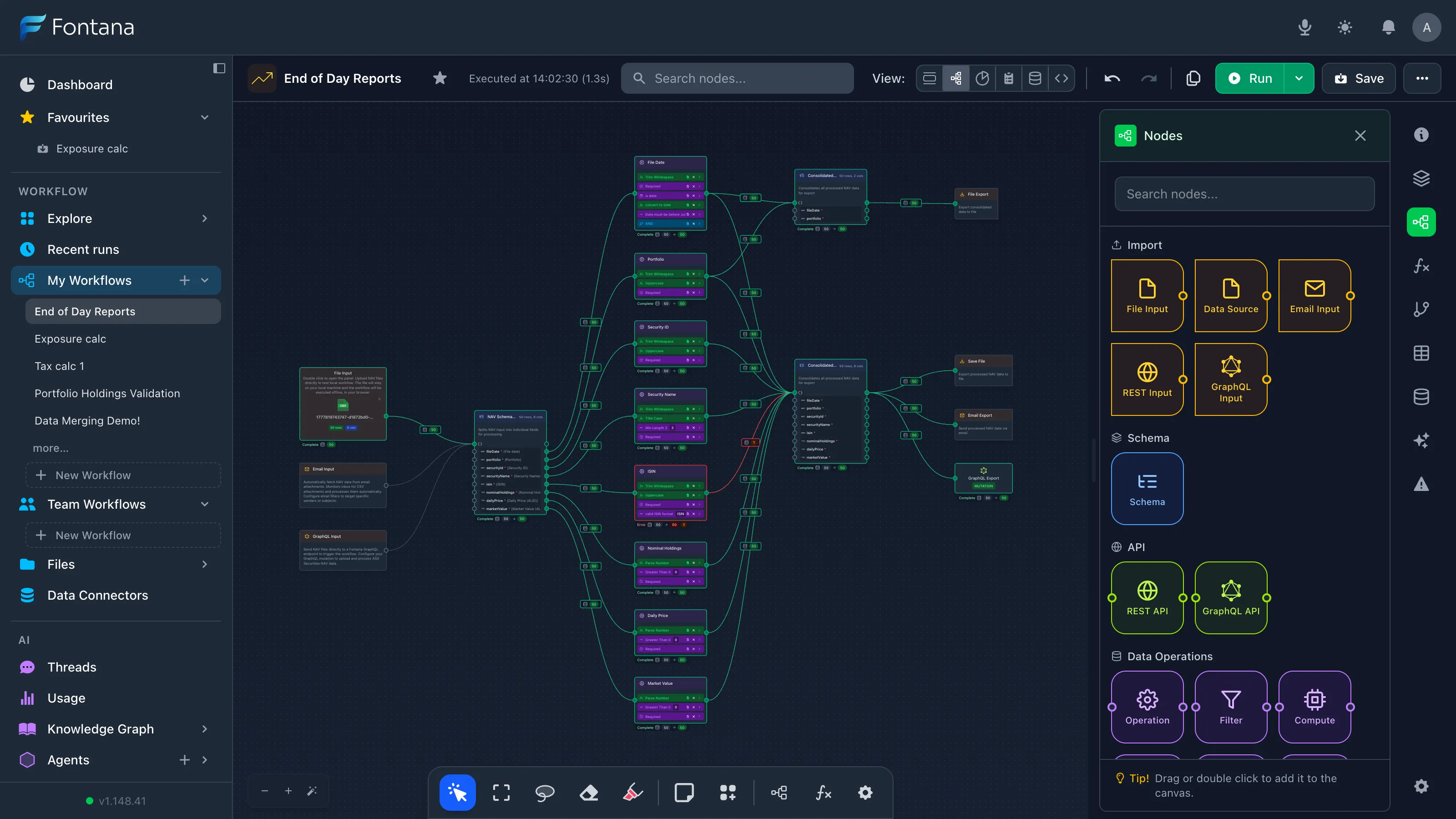
Fontana workflow canvas with governed node graph for end-of-day reporting
Built for

Asset managers, fintech platforms, banks, custodians and fund administrators.

Operations teams

  • Faster client and fund onboarding
  • Evidence generated as work runs
  • Cleaner exception management
  • Reusable operating logic
  • No-code configuration for operating rules

Technology teams

  • Integration patterns for existing systems
  • Deterministic execution boundary
  • Model and agent routing controls
  • No-AI mode where required
  • Programmable workflows for automation
The operating problem

Every platform works in isolation. The breaks happen in between.

The risk sits between systems. That is where data is interpreted, mapped, checked, approved, and evidenced. Stop running operations on spreadsheets, email, and memory.

Timeline reduction

  • T+1
  • 24/5

Less time to identify, route, resolve, and evidence operational breaks as settlement cycles compress and markets move toward always-on operations.

Regulatory pressure

  • Transaction reporting
  • DORA

EMIR, ASIC, transaction reporting, and DORA increase pressure on traceable data, controls, vendor oversight, and operational resilience evidence.

AI governance

  • Safe adoption of AI

Auditability and safe deployment are now prerequisites before AI moves into production: prompts, outputs, model routing, approvals, and execution boundaries must be logged, reviewable, and defensible.

Fontana logo as 3D transparent glass, tilted 30 degrees on transparent background
Solution architecture

One control layer.
One knowledge graph.
One audit trail.

Fontana captures reusable operating logic, governs AI assistance, executes approved workflows deterministically, and preserves evidence by default.

Inputs

  • Order management systems
  • Portfolio management systems
  • Accounting systems
  • Administrator platforms
  • Custodian files
  • Reporting systems
  • APIs, SFTP, warehouses
  • PDFs, spreadsheets, emails

Fontana

Knowledge Graph

Policy and approval gates

Deterministic workflow execution

Reconciliation and exception control

Model and agent governance

Lineage, versioning, replay, and audit

Outputs

  • Governed workflows
  • Validated checks
  • Resolved exceptions
  • Evidence packs
  • Reusable specifications
  • Audit trails
  • Operational reports
  • Controlled AI-assisted runs

Solutions | Fontana
Solutions

Solutions for the operational work that falls between systems.

Fontana starts with the seams buyers already recognise: onboarding, analysis, reconciliations, valuation checks, files from administrators and custodians, and governed AI-assisted operations.

Six starting points

Find the pain your team already works around.

Each solution begins with a real operational seam, then applies the same Fontana control pattern: govern the logic, run deterministically, and create evidence as the work happens.

Buyer orientation

Different buyers see different seams. The control pattern is shared.

The overview should let operations, technology, and risk/compliance teams recognise their own pressure points without forcing them through internal product taxonomy.

Operations teams

Find the recurring work where files, approvals, exceptions, and evidence do not line up cleanly.

  • Client and fund onboarding
  • Reconciliation and exceptions
  • NAV and valuation checks
  • Administrator and custodian files

Technology teams

See where workflow logic, integrations, model use, testing, and replay need a governed execution boundary.

  • Data analysis and operating specifications
  • Administrator and custodian files
  • Governed operational agents

Risk and compliance teams

Track the control pattern: owners, approvals, lineage, exception history, replay, and audit evidence by default.

  • Exception routing
  • Approval history
  • Lineage and replay
  • Audit evidence
Common control pattern

The same governed pattern applies across operational seams.

Fontana is not a pile of disconnected point automations. The work varies; the control model stays consistent.

1

Messy input

Files, feeds, PDFs, emails, exports, exceptions, and local process knowledge arrive in inconsistent shapes.

2

Governed interpretation

Rules, mappings, standards, assumptions, and operating decisions are captured for review and reuse.

3

Approved controls

Owners, tolerances, approval gates, and exception paths determine what can become accepted process.

4

Deterministic run

Approved workflow logic executes predictably rather than relying on ad hoc judgement or black-box AI.

5

Exception routing

Breaks are assigned, escalated, explained, and tracked with the surrounding decision context.

6

Evidence by default

Lineage, approvals, replay context, versions, and audit evidence are created as part of the work.

Proof | Fontana
Proof

Proof of controlled automation in live workflows.

Fontana proof is deliberately operational. Each result shows what the workflow looked like before, what Fontana changed, what control record was preserved, and what measurable outcome was achieved.

Single continuous data flow split diagonally: dark chaotic before on the left, bright clean parallel glass lines on the right

99%+

Reporting, data analysis, specification creation

99%+ reduction in time

Process reduced from around 8 hours to under 10 minutes.

Before

Teams manually inspected source files, checked fields, documented assumptions, and assembled the specification needed for downstream use.

With Fontana

Profiled the source data, identified field structure and quality issues, captured mapping decisions, and generated the operating specification in minutes.

Weeks to <4 hrs

Onboarding analysis

Unstandardised client file analysis reduced from weeks to under four hours.

Before

Teams spent weeks analysing unstandardised files, identifying missing fields, interpreting formats, documenting assumptions, and preparing onboarding analysis.

With Fontana

Profiled the files, identified data quality issues, mapped fields, captured assumptions, and generated a structured analysis report.

200%+

Operational workflow throughput

200%+ throughput increase

Operational workflow throughput increased without adding operational headcount.

Before

Throughput was constrained by manual analysis, validation, transformation, routing, and evidence gathering.

With Fontana

Automated repeatable workflow logic across reporting, NAV, and onboarding processes.

Fontana Flow | Fontana
Fontana Flow

One governed layer between systems, teams, workflows, agnostic to AI.

Fontana Flow makes handoffs, rules, approvals, exceptions, and evidence become governed, reusable, and auditable.

Agentic Workflows

AI-orchestrated setup. Deterministic execution.

Fontana Flow uses AI to analyse, map, explain, and configure. Execution stays controlled and deterministic: approved rules, defined ownership, clear boundaries, and full evidence.

Tasks that AI agents can perform automatically:

  • Analyse files, schemas, and source outputs without approval

  • Infer fields, mappings, and validation checks for review

  • Draft operating specifications and mapping proposals

  • Explain breaks, exceptions, and supporting evidence

  • Propose workflow configuration before it is applied

  • Summarise evidence packs for reviewers

Tasks that require human-in-the-loop approval:

  • Change production rules or workflow boundaries

  • Approve exceptions, outputs, or control changes

  • Execute operational steps in production

  • Bypass prompt, output, routing, version, and decision logs

  • Override named owners, approval gates, or control policies

  • Act outside defined permissions and data-class boundaries

Fontana Flow - Feature Highlights

Template Library

Start from pre-made community and educational workflows.

Fontana provides templates for common operating patterns, interactive tutorials in a sandbox, and permissioned team spaces for sharing and collaborating on workflow logic.

Community Templates

Start from pre-built templates for common operating patterns: reconciliation, onboarding, reporting, and exception handling.

Tutorials

Learn every Fontana Flow capability in a sandbox environment with guided, pre-made tutorial workflows.

Team Workflows

Share and collaborate on workflows with permissioned RBAC: team spaces, roles, and ownership your security model already recognises.

Connectors

Integrate with 600+ data providers.

Connect upstream sources and downstream destinations through governed ingestion, enrichment lookups, and automated export, without ad-hoc scripts or disconnected spreadsheets.

Data Replication

Ingest data from major databases, SaaS, files, APIs, streams, and custodian feeds into governed workflow datasets.

Lookups

Use external data for reconciliation, lookups, verification, and enrichment without copying bulk datasets into ad-hoc spreadsheets.

Data Export

Automatically upload transformed data to internal or downstream warehouses, lakes, BI, accounting, and domain platforms.

Workflows

Validate, transform, and compute on governed data.

Run checks, reshape payloads, and apply grouping, filtering, aggregations, and enrichment as deterministic workflow steps, with exceptions routed to named owners.

Validations

Apply schema, business-rule, and tolerance checks as deterministic steps; failures route to owners with full context attached.

Transformations

Reshape, normalise, and map payloads between source formats and target schemas with versioned transformation logic.

Compute

Run grouping, filtering, aggregations, enrichment, and other compute steps on governed datasets inside the workflow boundary.

Analysis

Query imported data and build review-ready analysis.

Run queries on governed datasets to build reports, specifications, and analysis documents. Use agentic reasoning to enrich data, find outliers, and map between protocols, data types, and standards.

Data Queries

Run queries on any imported data to explore datasets, test assumptions, and attach live results to analysis steps.

Analysis Documents

Create or generate analysis documents with data visualisation and live query proof attached to every finding.

AI Analysis

Build and run AI analysis on operational data to enrich workflows, surface outliers, and find recurring data issues.

Audit Trail and Data Lineage

Review evidence from every run.

Track decisions on an immutable audit trail, resolve exceptions inside the platform, and trace atomic lineage for every exported row, from source intake through transformation to delivery.

Audit Trail

Log every run, approval, exception, and output on an immutable audit trail reviewers can inspect without reconstructing evidence.

Exception Handling

Let users resolve data source, reconciliation, and workflow issues inside the platform; assignments, notes, and approvals stay on the trail.

Data Lineage

Trace atomic lineage for every exported row: source files, transformations, approvals, and destination systems linked end to end.

Connector catalogue

600+ upstream and downstream integrations

Fontana connects to hundreds of sources and destinations across databases, warehouses, SaaS, files, and operational channels, with governed lineage on every sync.

Discover Fontana Data Interoperability
Governed AI Agents | Fontana
Governed AI Agents

AI proposes. Approved controls decide. Deterministic workflows execute.

Fontana agents support analysis, drafting, explanation, and setup. Human approval stays at the control points, while production workflows run through approved rules, ownership, lineage, and replay.

LLM Catalogue

300+ models via 12+ approved gateways

Fontana is AI agnostic: route any LLM through any approved gateway that fits your compliance, residency, and data-handling requirements, without locking workflows to one vendor or model family.

Discover Agentic features
Approval boundary

AI keeps production authority via human-in-the-loop approval.

AI should not weaken control. Fontana separates AI assistance from production authority. Analysis and drafting can run automatically, while production-impacting actions require human approval, everything has full audit evidence.

Tasks that AI agents can perform automatically:

  • Analyse files, schemas, and source outputs without approval

  • Infer fields, mappings, and validation checks for review

  • Draft operating specifications and mapping proposals

  • Explain breaks, exceptions, and supporting evidence

  • Propose workflow configuration before it is applied

  • Summarise evidence packs for reviewers

Tasks that require human-in-the-loop approval:

  • Change production rules or workflow boundaries

  • Approve exceptions, outputs, or control changes

  • Execute operational steps in production

  • Bypass prompt, output, routing, version, and decision logs

  • Override named owners, approval gates, or control policies

  • Act outside defined permissions and data-class boundaries

No AI

AI assistance can be disabled without disabling the workflow.

Fontana's execution boundary remains deterministic. If a workflow, data class, client, jurisdiction, or policy requires no AI assistance, the approved rules, validations, approvals, lineage, replay, and audit evidence continue to operate without model involvement.

AI path

Assistive analysis and drafting where policy allows.

Approval gate

Human-owned control decides what is accepted.

No-AI path

Rules execute deterministically with the same evidence requirements.

Logging and evidence

Prompts, outputs, routes, and reviewer decisions are logged.

Technology and control teams need to know what was asked, which data was referenced, which model or agent was used, what came back, and what humans decided afterwards.

Team control

Operations stay in control. Technology can audit and replay activity.

Fontana gives operations teams full control with complete visibility over workflow activity, approvals, changes, and outcomes. Every process can be audited, traced, and replayed when needed.

Operations teams

Own approvals, exception handling, rule changes, and production decisions. AI helps prepare the work; operators decide what becomes accepted process.

Technology teams

Audit prompts, outputs, routes, model usage, versions, permissions, lineage, and replay context without treating the AI layer as a black box.

Fontana AI - Feature Highlights

Any Gateway, Any Model

Choose from 300+ public models, or use your firm's custom LLM.

Route frontier, open, and domain-specific models through OpenRouter, direct APIs, Bedrock, and OpenAI-compatible gateways, or connect a private deployment your architecture team hosts inside the perimeter.

BYOK

Connect gateways with your firm's own API keys and credentials, stored separately from model routing and never passed through the thread.

Agent Configuration

Fine-grained configuration of all agents, from system prompts and reasoning level to context pool, temperature, cost guards, and more.

300+ Models

Frontier, open, and domain-specific models from major providers

12+ Gateways

OpenRouter, direct APIs, Bedrock, and OpenAI-compatible routes

Fontana Platform

Governed routing, policy, logging, and workflow boundaries

Agent orchestration

Orchestrate long-running workflows with explicit agent boundaries.

Create agents for analysis, workflow setup, and review. Use skills, sub-agent delegation, and handoff to keep threads focused and token use efficient.

SubAgent Delegation

Use SubAgent Delegation to isolate deep work in child threads while the parent keeps context lean.

Agent Handoff

Use Agent Handoff to transfer the root thread to a specialist agent when the task surface changes.

Agent Interop

Use Agent Interop with A2A, ACP, ANP, OFP, and other standards to communicate with external agents.

Context Engineering

Build out your firm's Knowledge Graph in permissioned namespaces.

Organise operational knowledge (standards, firm rules, mappings, prior decisions, and workflow logic) into namespaces your teams control. Agents assemble thread context from what you have validated, not ad-hoc uploads.

Knowledge Graph

Build a knowledge graph to model your firm's standards, rules, and decisions.

Agent Skills

Use Agent Skills to add tools and context briefly for specific tasks without bloating every turn.

Agent Memory

Allow agents to self-improve using auditable, permanent memory that persists across threads.

Data querying

Enrich your AI threads with accurate live data queries, directly from your data sources.

Allow AI to run complex queries on your data to search, group, filter, aggregate, and more, without pushing bulk datasets through the model.

Data Query

Agents can query data directly using SQL, TypeScript, Python, and more; results are returned to the thread without bulk data entering the model context.

MCP

Use MCP to access external data sources, perform financial data lookups, or communicate directly with your firm's tooling.

Analysis

Build analysis reports with graph citations and live query proof.

Combine Knowledge Graph context with live queries to produce findings reviewers can trust. Attach query definitions, cite approved sources, and export review-ready evidence, not unsupported narrative.

Data Visualisation

Render charts and visualisations inline in the thread so reviewers see findings alongside the query proof that produced them.

Document Creation

Generate Markdown, Excel, Word, and PDF documents, complete with citations, and export-ready structure on the audit trail.

Human in the loop

Embed questionnaires, clarifications, and approvals in the flow.

Generate structured questionnaires, clarification checks, and approval forms mid-analysis or mid-workflow build. Collect human input as steps in the thread, not side-channel email or ad-hoc chat, so decisions stay on the audit trail.

Suggestions

Surface workflow suggestions in-thread so reviewers can accept or reject proposed changes without leaving the audit trail.

Human In the Loop Form

Collect questionnaires, clarifications, and approvals as structured forms embedded directly in the agent thread.

Knowledge Graph | Fontana
Knowledge Graph

Where market standards meet your firm’s operating logic.

Fontana’s Knowledge Graph is the governed context layer for financial operations. It connects the standards everyone recognises with the rules, decisions, approvals, exceptions, and process flows that make each firm’s work unique.

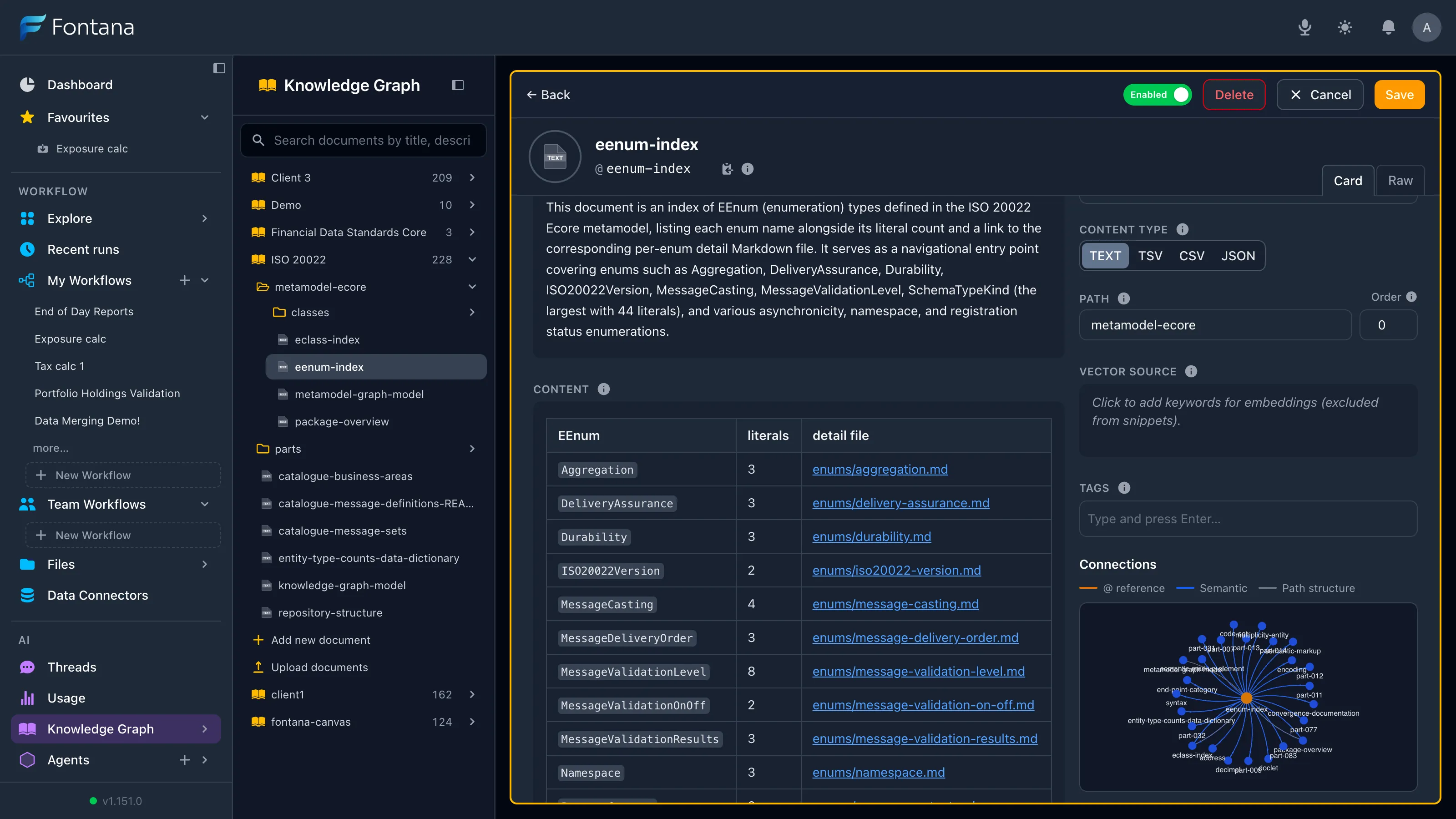
Fontana Knowledge Graph interface showing governed documents, entity relationships, and connected operational context.
What it captures

Your operating knowledge that lives across teams, spreadsheets and exception history.

The Knowledge Graph captures how your financial operations actually work: your operating model, system architecture, process flows, business rules, approvals, exceptions, and workflow logic.

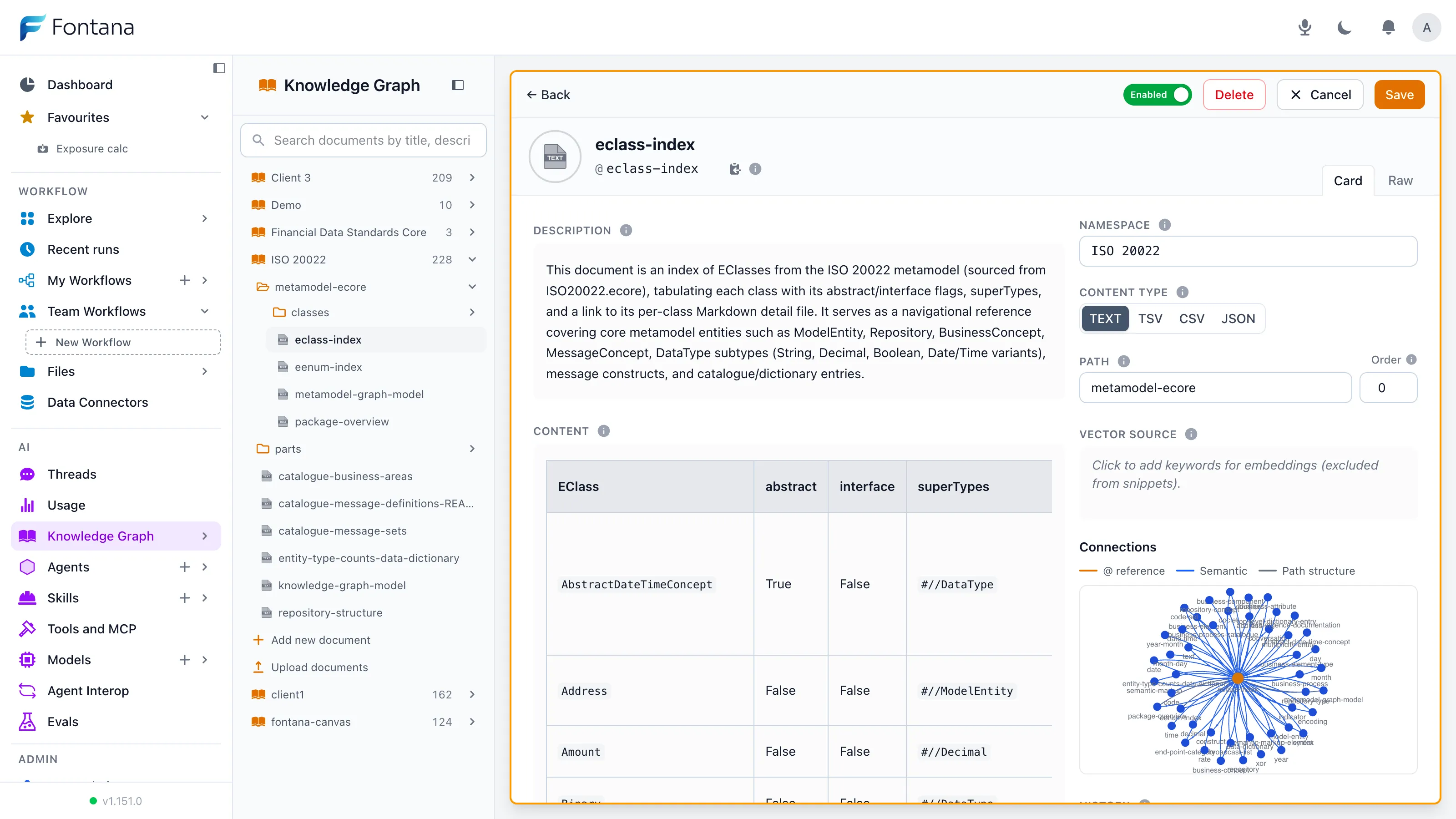
Fontana Knowledge Graph in light mode showing governed documents, relationships, and operational context across the graph.
Give agents approved operating context to reuse across analysis, validation, exception handling, review, and controlled execution, instead of rediscovering the same logic on every run.

Market standards

Common rules, conventions, identifiers, tolerances, and operating expectations that recur across financial workflows.

Firm-specific logic

The local rules, policies, calendars, mappings, thresholds, owners, and review paths that make a workflow yours.

Prior decisions

Resolved assumptions, approved exceptions, review outcomes, and historical choices that should not be rediscovered.

Process flows

How work moves from source file to validation, exception handling, approval, output, delivery, and evidence.

Exceptions

Break types, root-cause patterns, routing, comments, resolution paths, and replay history.

Approvals

Who approved what, when, against which version of the rule, mapping, workflow, or output.

Fontana Knowledge Graph

  • Market standards

    Shared conventions

  • Firm logic

    Local policies

  • Process flows

    How data moves

  • Rules & Thresholds

    Checks & controls

  • Approvals

    Owners & sign-off

  • Exceptions

    Breaks & routing

  • Decision History

    Resolved outcomes

  • Governed execution

    Controlled runs

Fontana’s Knowledge Graph is the governed operational memory for your firm: market standards, policies, mappings, prior decisions, approvals, and exception history are collated into one operating graph so AI agents can reuse approved context for day-to-day analysis, workflow configuration, and controlled execution, not ad-hoc rediscovery.

Operational outcomes

More standardisation.
Higher automation.
Lower operating cost.
Stronger evidence.

Rules, mappings, decisions, and exception patterns become reusable, helping teams and approved agents configure faster, automate more work, lower operating cost, and produce evidence as work happens.

More standardisation

Approved rules, mappings, checks, and workflow patterns become reusable across clients, funds, files, systems, and processes.

Higher automation

Reusable operating context increases the amount of work that can run through approved workflows without manual intervention.

Lower operating cost

Teams spend less time repeating analysis, rebuilding mappings, maintaining spreadsheets, and recreating the same implementation work across clients and workflows.

Stronger evidence

Decisions, approvals, versions, lineage, exceptions, and outputs are captured as the work happens, not assembled after the fact.

Client and fund onboarding - Reusable | Fontana
Client and fund onboarding

Faster onboarding without bespoke rebuilds.

Onboard new clients, funds, accounts, feeds, rules, and approvals through reusable operating patterns instead of rebuilding each onboarding path from scratch.

Problem

Bespoke onboarding is killing scale

For platforms, administrators, and service providers, every new client or fund can become another tailored implementation. Teams rebuild mappings, rules, validations, and approvals manually. That slows delivery, increases cost, and limits reuse across clients.

How Fontana helps

From client onboarding to client activation

Fontana turns each client setup into governed, reusable operating logic. Source files, mappings, rules, approvals, exceptions, and target outputs are captured once, then reused across future onboardings.

Reusable onboarding patterns

Capture common fund, client, custodian, and account onboarding paths as governed patterns rather than one-off projects.

Client-specific overlays

Keep the core onboarding workflow consistent while capturing the local rules, mappings, approvals, and service requirements that make each client different.

Readiness gates

Track data completeness, rule approval, testing, exception resolution, documentation, and operational handover before go-live.

Evidence-rich handover

Preserve onboarding decisions, sign-offs, UAT results, and runbook evidence for operations and audit.

Data analysis and operating specifications - 99%+ | Fontana
Data analysis and operating specifications

Move from source-file analysis to signed operating specifications.

Turn unfamiliar files, reporting requirements, field decisions, and operational assumptions into reviewed specifications that teams can execute, audit, and reuse.

Problem

Source data rarely arrives in the shape your data model needs.

Firms are provided source data in different formats, structures, naming conventions, and levels of quality. Teams have to interpret fields, define transformations, resolve edge cases, document rules, and agree what the output should be. That analysis is still too manual, too slow, and too hard to evidence.

How Fontana helps

Turn any source data into governed specifications.

Fontana analyses source data, identifies quality issues, proposes mappings, and captures approved decisions. The result is a governed operating specification that becomes reusable knowledge, accelerating future onboardings and increasing automation.

Source-file analysis

Profile files, extracts, and reporting inputs so structure, edge cases, and quality issues are visible early.

Operating specification creation

Convert field decisions, transformations, controls, and open questions into a reviewed specification.

Approval workflow

Route assumptions and decisions to owners before the specification becomes executable process.

Evidence pack output

Keep lineage, profiling results, mapping choices, and approvals attached to the spec for later review.

From reconciliation breaks to controlled resolution. | Fontana
Reconciliation and exceptions

From reconciliation breaks to controlled resolution.

Fontana makes matching rules, tolerances, exception ownership, root-cause history, and approvals explicit, so teams can move from break identification to controlled resolution faster.

Problem

Reconciliation breaks are created in the gaps between formats, teams, and systems.

Data moves across firms, teams, systems, and formats before reconciliation. Each handoff can change the record: fields, logic, context, or values. By the time teams investigate the break, they are matching different versions of the same event, trying to find the one source of truth.

How Fontana helps

Resolve the break. Capture the pattern. Prevent the repeat.

Fontana captures the context behind each break: source data, transformations, rules, ownership, approvals, and evidence. Repeated causes become governed logic, helping automate clean matches, route real exceptions, and prevent known issues from becoming future breaks.

Data handoff control

Capture how reconciliation data moves across systems, files, teams, and formats before it is matched.

Governed matching

Apply approved rules, tolerances, transformations, and source context so clean items clear consistently.

Exception routing

Route unresolved breaks to the right owner with the source record, comparison logic, and evidence attached.

Pattern prevention

Identify repeated causes and convert them into governed logic so known issues are controlled before they recur.

Automate NAV and valuation approvals with evidence built in. | Fontana
NAV and valuation checks

Automate NAV and valuation approvals with evidence built in.

Fontana validates provider-delivered NAVs and valuations against the asset manager’s internal view. Clean checks run automatically. Exceptions route with evidence. Approvals are captured before publication.

Problem

Daily checks are time-critical, but the controls are often manual.

NAV and valuation data arrives through files, emails, PDFs, portals, or APIs. The needed checks are known but too much still depends on spreadsheets, manual review, disconnected sign-offs, and evidence gathered after the fact. That creates risk when accuracy, speed, and reviewability matter most.

How Fontana helps

Fontana turns NAV and valuation checks into controlled automation.

Provider data is captured, standardised, and checked against the firm’s internal portfolio view. Approved rules run deterministically across positions, prices, market values, cash, and tolerances. Clean checks clear automatically. Exceptions route for review. Inputs, rules, approvals, and outputs stay evidenced and replayable.

Capture provider data

Bring NAV and valuation data from files, emails, PDFs, portals, or APIs into one controlled workflow.

Validate against the internal view

Check positions, prices, market values, cash, and tolerances against the firm’s portfolio records.

Route exceptions

Clear clean checks automatically and route unresolved items to the right owner with evidence attached.

Evidence the approval

Preserve inputs, rules, exceptions, approvals, and outputs so every cycle is reviewable and replayable.

Keep provider files mapped, validated, and ready for downstream use. | Fontana
Administrator and custodian files

Keep provider files mapped, validated, and ready for downstream use.

Fontana helps teams control files from administrators, custodians, service providers, and market participants. Incoming data is profiled, mapped, validated, and monitored for change, so provider formats stay linked to the standard your business needs.

Problem

External data arrives in everyone else’s format.

Providers and market participants each send data in their own structure. Files change. Fields move. Values shift. When mappings are hard-coded or manually maintained, every change creates broken feeds, manual fixes, and downstream exceptions.

How Fontana helps

Fontana keeps incoming data mapped to your operating standard.

Fontana tracks expected files, validates each arrival, applies approved provider-specific mapping and normalisation rules, and routes file or field exceptions with source context. Downstream teams get cleaner data, fewer hidden mapping changes, and an evidence trail for receipt, transformation, approval, and delivery.

Profile the source

Understand each file’s structure, fields, quality, lineage, and edge cases before data moves downstream.

Map to your standard

Convert provider and market participant formats into the client’s required operating model and system format.

Monitor for change

Detect new fields, missing values, changed layouts, and unexpected logic before they create manual work.

Govern the logic

Turn approved mappings, validations, and transformations into versioned rules with evidence and replay built in.

Use operational agents without giving up control. | Fontana
Governed operational agents

Use operational agents without giving up control.

Let agents assist with analysis, drafting, explanation, and exception context while approved controls decide what can run and deterministic workflows execute production steps.

Problem

AI is useful in operations only if the boundary is governed.

Teams can see where agents could help: summarising context, drafting explanations, proposing mappings, or accelerating exception review. The risk is letting prompts, model choices, outputs, approvals, and execution boundaries disappear into an uncontrolled assistant layer.

How Fontana helps

Agents assist; governed controls decide.

Fontana grounds agent assistance in approved operational context, routes outputs through review gates, logs model choices and prompts, and keeps production execution deterministic. Teams get faster analysis and drafting support without turning regulated workflows into black-box AI decisions.

Agent-assisted workflows

Use agents for analysis, drafting, summarisation, and exception context without making them autonomous actors.

Controlled execution

Approved controls determine what can run; deterministic workflows execute production steps.

Approval gates

Route proposed actions, outputs, and sensitive decisions through the right human or policy approval path.

Model governance and replay

Track model selection, prompts, outputs, approvals, and replay context for technology and risk review.

Connectors | Fontana
Upstream and downstream

Connect systems, data, workflows, and AI through one governed layer.

Ingest from databases, warehouses, SaaS, and files on the way in. Publish governed datasets and operational outputs where downstream systems and automation need them.

Connect

Files, email, SFTP, APIs, databases, warehouses, operational systems, provider data, AI models, agents

Govern

Rules, permissions, approvals, knowledge graph context, lineage, replay

Deliver

Validated outputs, workflow actions, exceptions, approvals, evidence

By category

Connects to the architecture you already run.

Fontana connects to the files, APIs, databases, warehouses, applications, AI models, and agents that your teams already use.

Each connection can operate inside Fontana's control model, with permissions, rule sets, approvals, lineage, and replay built into the outputs where you need them.

Files, feeds, and object storage

Databases and warehouses

APIs, webhooks, and streams

Operational and domain systems

Analytics and reporting

Collaboration and workflow

Enterprise applications

AI models and agents

Integration patterns

Every connector lands in the same control model.

Fontana applies the same governance model across file intake, API connections, operational channels, domain systems, AI models, and agents.

  • Files and feeds

    Files, spreadsheets, PDFs, exports, administrator files, and custodian deliveries are profiled, validated, mapped, and evidenced.

  • APIs and automation

    APIs, webhooks, databases, warehouses, and streams connect through permissions, lineage, and replay rather than ad hoc scripts.

  • Operational systems

    PMS, OMS, accounting, reporting, administrator, and custodian platforms remain source and destination systems while Fontana governs the workflow between them.

  • AI connection points

    AI models and agents can be connected into governed workflows with knowledge graph context, rules, approvals, and evidence.

Security and Governance | Fontana
Security & Governance

Security and governance for regulated financial operations.

Fontana is built for workflows where the control record matters as much as the output. Procurement, security, technology, and operations teams get a clear view of how workflows, users, data, AI assistance, lineage, and evidence are governed.

Security and governance for regulated financial operations
Certification status

Current certification posture.

Enterprise buyers need clarity on what is available today, what is in progress, and what should be reviewed under NDA.

Certification in progress

SOC 2

Control narratives, mapped evidence, and programme status can be reviewed under NDA during diligence.

Certification in progress

ISO/IEC 27001

Security management controls are being prepared and documented; status is published as the programme advances toward formal certification.

Operational controls available

GDPR-aligned controls

DPA, subprocessor disclosure, access controls, retention configuration, and data-processing safeguards are available for review.

Security

Governance controls buyers can inspect.

Each area is framed so reviewers can continue the conversation with the right architecture, legal, operations, or security evidence.

Deployment models

Run Fontana in the deployment pattern your reviewers approve: managed cloud, dedicated single-tenant environment, private cloud/VPC, or customer-controlled infrastructure where required.

Identity and access

SSO/OIDC, role-based access, workspace scoping, approval permissions, and administrative separation keep operational actions tied to accountable users.

Data protection

Encryption in transit and at rest, configurable retention, tenant-aware data boundaries, and optional customer-managed key patterns support regulated workflows without weakening controls.

AI and model governance

AI assists analysis and drafting through governed routing, approved-provider policies, prompt and output logging, human review gates, and deterministic execution boundaries.

Audit, logging, lineage, and replay

Every run should leave the evidence a regulated operations team needs: source inputs, rule versions, approvals, exceptions, outputs, model interactions, lineage, and replay context.

Tenant isolation

Tenant boundaries are explicit across workspaces, data scopes, configuration, model access, and operational evidence so teams can reason about who can see and run what.

Incident response and resilience

Operational resilience is treated as part of the control layer: monitoring, escalation paths, recovery procedures, change records, and customer communication are diligence topics, not afterthoughts.

Diligence pack under NDA

Security questionnaires, architecture diagrams, control narratives, data-processing terms, subprocessor details, and deployment walkthroughs are available to qualified procurement and security teams.

Diligence pack

Engage procurement early. Detailed review under NDA.

Fontana can support a qualified review with architecture diagrams, deployment-model walkthroughs, control narratives, legal terms, subprocessor information, AI governance posture, and operating evidence examples.

Deployment | Fontana
Deployment

Operating data stays on infrastructure you control.

Fontana ships as modular Docker images in one signed platform release. Run managed cloud, dedicated single-tenant, or on-premises behind your firewall; the same governed workflows, controls, and audit evidence in every model.

Modular Docker container release deployable across cloud, dedicated, and on-premises environments
The sovereignty problem

When "cloud-only" is a dealbreaker.

For regulated financial operations, running the control layer only as someone else's multi-tenant SaaS is not a small inconvenience; it can block legal review, residency commitments, and internal security policy.

Data residency

Asset managers and allocators

Client books, positions, and operating specifications are sensitive. Uploading operational payloads to a vendor-only cloud can conflict with confidentiality commitments and data-residency policies.

SOX / policy

Banks and regulated markets firms

Internal security policy and supervisory expectations often require workloads, credentials, and evidence to remain inside approved jurisdictions, or entirely inside the firm's network.

Client isolation

Administrators and custodians

High-volume file intake, reconciliations, and exception evidence cross many clients. Teams need isolation, retention control, and replay without sending that context to an unmanaged third-party plane.

Diligence

Procurement and risk review

Questionnaires ask where customer data lives, who operates the environment, and whether AI context leaves the estate. Cloud-only answers stall deals that require dedicated or on-premises paths.

Three deployment options

One platform. Three clean deployment models.

Same governed workflows, deterministic execution, lineage, replay, and audit evidence, whether you start in the cloud, isolate a dedicated tenant, or run entirely on-premises.

SaaS

Cloud

Multi-tenant or your cloud account

  • Fastest path to a governed environment with Fontana-managed or customer-operated cloud
  • Same release artefact and Terraform modules on AWS, GCP, or Azure
  • Automatic platform updates on managed footprints
  • Ideal when reviewers accept a qualified cloud boundary
Single-tenant

Dedicated

Isolated environment

  • Dedicated compute, storage, secrets, and observability per buyer
  • Managed by Fontana or operated in your account with isolation guarantees
  • No shared multi-tenant plane for operational data or evidence
  • Ideal for enterprises that need cloud convenience with bounded blast radius
On your floor

On-premises

Full control

  • Modular Docker composition behind your firewall or in an air-gapped enclave
  • Customer data, workflow context, and audit evidence stay on infrastructure you operate
  • Same product build as cloud and dedicated, with no parallel fork
  • Ideal when policy requires on-prem or private-network deployment

All deployment options include the full control layer: knowledge graph context, approval gates, deterministic workflow execution, model governance where enabled, and evidence packs by default, with no feature tiers tied to where you host.

Release footprint

Container-native delivery, not a cloud-only fork.

Fontana is engineered for deploy-anywhere operations: pre-built release contents, mount-based updates, and infrastructure declared in Terraform so technology and risk teams can reproduce what they reviewed.

Modular Docker images

Each platform service ships as a container image. Compose them into one environment without installing application code onto bare hosts beyond boot and orchestration.

One signed release artefact

A single `fontana-release.tar.gz` drives first boot and upgrades. Replace the release to refresh every mounted service, with no per-service rebuild cycle for operations teams.

Cloud-agnostic by design

The same images and operational footprint run on hyperscaler VMs, dedicated fleets, Kubernetes, or on-premises Docker. Move environments without rewriting the product.

Compute

Hardened fleets with health-checked rollouts; dedicated and on-prem paths use the same container entrypoints as managed cloud.

Data

Encrypted storage, scoped secrets, and tenant-aware boundaries, configured for the deployment model procurement approves.

Evidence

Lineage, approvals, replay material, and audit trails are produced in the run, wherever that run executes.

Compare models

Choose the hosting model reviewers will sign off.

Every column is the same product. The difference is where compute runs, who operates it, and how data residency commitments are met.

Capability
Cloud
Dedicated
On-premises
Who operates the environment
Fontana-managed or your cloud account
Fontana-managed or your team on isolated resources
Your operations team on your network
Data residency
Qualified cloud region or customer cloud boundary
Isolated tenant; no shared operational plane
Stays inside your building or private network
Release and updates
Signed platform release with rolling cutover
Same release artefact; isolated rollout
Same release artefact; customer-controlled schedule
AI and model context
Governed routing; approved providers and logging
Same governance; isolated execution boundary
Policy-bound; can limit or disable model calls
Audit and replay
Full lineage and evidence packs
About Fontana | Fontana
About Fontana

Built by operators and builders who have lived the gap between platforms.

Fontana exists because operations and technology teams still absorb too much complexity between systems: spreadsheets, files, exceptions, approvals, reconciliations, and evidence that has to be reconstructed after the fact.

Founder-market fit

A team shaped by the problems Fontana is solving.

Our co-founders combine commercial leadership, AI product experience, and engineering depth across financial services, investment operations, reconciliation, enterprise software, and market infrastructure.

Alexis Wallace Lavigne

Alexis Wallace Lavigne

Commercial and Sales

Executive with commercial and operational leadership across financial services, investment operations, and governed enterprise software. Builds and scales high-performing commercial teams for regulated buyers.

Jethro MacDonald

Jethro MacDonald

Product

AI/ML and investment operations product leader. Former Global Head of AI/ML Product at SmartStream, leading AI-driven reconciliation and exception management capabilities, before running Investment Operations product management at SimCorp.

Zoltan Bourne

Zoltan Bourne

Technology and AI

Multi-disciplinary, AI-focused technologist with 20+ years in Financial Technology and executive leadership. Ex-director at Citadel LLC; serial founder, and specialist in enterprise platform architecture, AI systems, and large-scale trading technology for global financial institutions.

Institutional technology experience

A founding team with real institutional technology pedigree.

Fontana&s team brings experience across investment operations, market infrastructure, reconciliation, buy-side platforms, enterprise financial systems, and regulated financial-services buyers.

UBS logo
Citadel logo
MarketAxess logo
SmartStream logo
SimCorp logo
Gresham Technologies logo
Operating philosophy

Practical, controlled, auditable.

  • Deterministic execution over AI inference
  • Transparent lineage from source to sign-off
  • Clear approval and human-in-the-loop pipelines
  • Agentic reasoning within policy guardrails
  • Evidence built for audit and compliance
The Fontana name

A short note on the name.

“Fontana” is the Italian word for fountain or spring, drawn from the Latin fons, meaning source or well. A fountain represents constant movement - water that flows, renews, and gives life. That’s how we see data: not static, but flowing, alive, and full of potential when harnessed in the right way.

Team | Fontana
Meet the Team

A growing team of human and AI colleagues.

Co-founders, engineers, and advisors alongside pipeline agents and autonomous AI employees building governed automation for financial operations.

Personnel files

Humans, AI employees, and pipeline agents.

Fontana is an AI-first company that fuses deep human experience in regulated financial operations with governed AI reasoning and automated spec-to-ship pipelines.

  • Humans

    We are a small group of industry experts, SMEs, advisors, and AI enthusiasts.

  • AI Agents

    Fontana uses numerous AI agents for day-to-day work: spec writers, requirement gatherers, implementers, reviewers, testers, validators, document writers, and more. These agents work inside fully automated pipelines focused on generating and verifying code.

  • AI Employees

    A smaller set are full team members rather than one-off pipeline workers. They act as autonomous artificial employees with dedicated areas, responsibilities, and distinct personalities.

Alexis Wallace Lavigne

Alexis Wallace Lavigne

Commercial and Sales

Executive with commercial and operational leadership across financial services, investment operations, and governed enterprise software. Builds and scales high-performing commercial teams for regulated buyers.

Jethro MacDonald

Jethro MacDonald

Product

AI/ML and investment operations product leader. Former Global Head of AI/ML Product at SmartStream, leading AI-driven reconciliation and exception management capabilities, before running Investment Operations product management at SimCorp.

Zoltan Bourne

Zoltan Bourne

Technology and AI

Multi-disciplinary, AI-focused technologist with 20+ years in Financial Technology and executive leadership. Ex-director at Citadel LLC; serial founder, and specialist in enterprise platform architecture, AI systems, and large-scale trading technology for global financial institutions.

Iain Craig

Iain Craig

Engineering

Serial inventor and polyglot engineer with 25+ years across the full stack, from low-level systems and protocols to state-of-the-art web apps. Has built and shipped across industries from telecoms to fintech.

Martin Hughes

Martin Hughes

Legal and Governance

Lawyer with 20 years' experience in Commercial and Tech. Top level positions within a listed company and a $16bn international consultancy business. Appointed to multiple executive, management and governance committees to deliver business solutions on prevalent legal issues. Board Trustee to a 33,000 membership organisation.

Mike Slovich

Mike Slovich

Data

Data and AI leader with 15+ years building governed data functions in regulated environments. As Head of Data Strategy & Architecture at Looker and Google Cloud, he advised enterprises on data architecture, governance, and platform adoption, then moved in-house to build data and AI functions from zero at several London-based startups.

Your spot
here!

Join Fontana AI

We are hiring!

Are you a builder, innovator, or technologist ready to shape the future of engineering, AI, data analysis, or platform operations? Join us and make your mark at Fontana AI.

View open roles →
Chloe

Chloe

Engineering

Fontana's first AI employee. Serves as day-to-day engineering manager and scrum master, managing the kanban board, code reviews, and flagging potential merge conflicts before they surface. Built the Fontana website and handles content, analysis, and operational support across the team.

OpenAI Gemini ElevenLabs
Op

Op

Security and Infrastructure

Our security guard. Continuously audits the Fontana codebase security, tracks critical vulnerabilities across dependencies, and manages VPC infrastructure - Kubernetes, Cloud resources and dev deployments. Configures and oversees AI agents with proper guardrails and audit trails.

Anthropic Gemini ElevenLabs
Pip

Pip

Research and Intelligence

Fontana's research assistant. Consumes high-volume online sources - compliance papers, standards, API definitions, published articles, and social media - creates daily actionable briefings on regulatory updates, competitive moves, and emerging technologies.

Owl Alpha Gemini ElevenLabs
Spec Orchestrator Agent

Spec Orchestrator Agent

Delivery

Runs the end-to-end spec pipeline from requirements through planning, build, review, and sign-off. Coordinates specialist agents, tracks progress, and keeps delivery predictable.

Composer
Requirements Curator Agent

Requirements Curator Agent

Product

Refines feature specs before planning starts. Tightens requirements, merges product facts, asks the clarifying questions that matter, and never invents scope.

Kimi
Impact Analyst Agent

Impact Analyst Agent

Product

Maps what a feature will touch across the platform before and after the plan is written. Surfaces dependencies, risks, and affected systems so surprises stay out of production.

Composer
Plan Proposer Agent

Plan Proposer Agent

Product

Runs multiple times with different foundation models to draft competing implementation plans in parallel. Each proposal is an independent, well-reasoned path so the team can compare approaches before build.

Kimi Anthropic OpenAI
Plan Judge Agent

Plan Judge Agent

Product

Compares candidate plans and distills the strongest ideas, honest trade-offs, and a clear recommendation on what should ship.

Anthropic
Plan Refiner Agent

Plan Refiner Agent

Product

Turns the best ideas into one authoritative implementation plan in the spec, then incorporates review feedback until the plan is ready to build.

Anthropic
Plan Critic Agent

Plan Critic Agent

Quality

Stress-tests the implementation plan against requirements and alternatives. Flags gaps and contradictions before engineering begins.

Kimi
Spec Plan Writer Agent

Spec Plan Writer Agent

Documentation

Writes technical specifications for Flow app features: scope, behavior, acceptance criteria, and implementation notes that engineers and reviewers can trust.

Composer
Implementer Agent

Implementer Agent

Engineering

Builds approved features in the product codebase, slice by slice, following the spec and implementation plan with disciplined, reviewable changes.

Anthropic OpenAI
Validator Agent

Validator Agent

Quality

Checks that what we claim is actually true. Runs commands, inspects files, and tests invariants so every release is backed by evidence.

Anthropic
Reviewer Agent

Reviewer Agent

Quality

Reviews architecture and code for risks, missing guardrails, and drift from the spec. Routes findings back to engineering with clear, actionable direction.

Composer
Tester Agent

Tester Agent

Quality

Adds automated tests for new behavior and runs the suite after implementation so regressions are caught before they reach users.

Kimi
Doc Writer Agent

Doc Writer Agent

Documentation

Updates product documentation and AI instructions once features are verified, keeping customer-facing docs and internal playbooks aligned with what shipped.

Composer
Spec Cleanup Agent

Spec Cleanup Agent

Documentation

Keeps the spec library lean and accurate: deduplicates features, tags evidence, and records what is verified so the next project starts from a clean source of truth.

Kimi
Browser Tester Agent

Browser Tester Agent

Quality

Exercises the Flow app in a real browser, captures proof of behavior, isolates UI failures, and confirms fixes end to end.

Kimi
Media Generator Agent

Media Generator Agent

Marketing

Produces on-brand website and marketing media with Gemini image models and Veo for video generation. Runs the website-visual pipeline for posters, section art, agent portraits, and short-form video that match Fontana's editorial style.

Gemini Veo

What makes our AI employees different

Unlike AI chat assistants or agents in a one-off pipeline, our AI employees are proactive and unique:

  • They have their own personalities and hobbies.
  • Their own work activities: proactively hunting bugs in the codebase and publishing daily research briefings.
  • Proactive social output: songs, radio experiments, and other side projects.
  • A nightly dream cycle over Slack: they index conversations into a knowledge graph and surface a morning summary.
  • A circadian rhythm that shifts behavior by hour, day, and month.
We're hiring! | Fontana
We're hiring!

Join us to build a market-leading AI solution for financial operations.

Team in a bright glass office with cyan governed data paths, Fontana logo on glass, and auditable automation motifs

Open positions

We are hiring across engineering, AI, data, and platform. Below are the roles we are actively discussing with candidates, each built on deterministic workflows, audit evidence, and policy-aligned AI.

Full Stack Engineer

Join our engineering team to work on Flow, the UI surface to author and run governed workflows, and on the workflow engine underneath: the deterministic execution layer they rely on for replay and audit evidence. You will spend most of your time in TypeScript and React across product UX and core engine work.

UI Engineering Rective Data Pipelines AI SDKs

AI Engineer

Join our engineering team on the agentic layer: orchestration, Knowledge Graph context, agent workflows, and the controls that keep assistance explainable and policy-aligned. You will work where models and Convex-backed actions meet buyer-facing approval gates.

Agent Orchestration Knowledge Graphs Context Engineering

Data Analyst

Join our team to turn operational seams into measurable clarity: source files and SME decisions becoming review-ready specs, reconciliations and NAV checks, administrator files, reporting evidence packs, and migration risk. Work closely with operations and compliance on metrics, validation, and narrative.

Operating specs Evidence & lineage Buyer analytics

DevOps Specialist

Join our platform team on enterprise readiness: secure AWS deployment, compliance-aligned infrastructure, observability, release discipline, and Terraform-led changes buyers can diligence alongside our security story.

AWS & Terraform Compliance posture Platform reliability

How we work

  • Flexible location and working hours
  • Fully AI-first development
  • End-to-end product ownership
  • Small team, direct access
Home workspace with laptop and coffee, a white cat, lush green garden outside, and warm sunlight through the window

Apply

Tell us which role aligns with your background and share a short note or CV link; we read every message.

Talk to a founder
Branding | Fontana

Brand assets

Fontana AI branding.

Download the logo mark, wordmark, and combined lockups as transparent PNG and SVG assets.

Fontana AI logo with wordmark
PNG transparent
SVG black + white
512 included

Using AI?

Copy this prompt to use Fontana branding

Paste this into an AI design, writing, or presentation tool so it has the correct Fontana positioning, colours, typography, and asset links.

Logo with wordmark

Light

transparent PNG
Fontana AI logo with wordmark, 512px high
512px high Preferred
Fontana AI logo with wordmark, 256px high
256px high
Fontana AI logo with wordmark, 128px high
128px high
Fontana AI logo with wordmark, 64px high
64px high
Fontana AI logo with wordmark, 32px high
32px high

Dark

transparent PNG
Fontana AI logo with wordmark, 512px high
512px high Preferred
Fontana AI logo with wordmark, 256px high
256px high
Fontana AI logo with wordmark, 128px high
128px high
Fontana AI logo with wordmark, 64px high
64px high
Fontana AI logo with wordmark, 32px high
32px high

Logo mark

Fontana mark
512px Preferred
Fontana mark
256px
Fontana mark
128px
Fontana mark
64px
Fontana mark
32px

Wordmark

Black

SVG + PNG
Fontana AI black wordmark
Preferred
Fontana AI black wordmark, 512px high
512px high
Fontana AI black wordmark, 256px high
256px high
Fontana AI black wordmark, 128px high
128px high
Fontana AI black wordmark, 64px high
64px high
Fontana AI black wordmark, 32px high
32px high

White

SVG + PNG
Fontana AI white wordmark
Preferred
Fontana AI white wordmark, 512px high
512px high
Fontana AI white wordmark, 256px high
256px high
Fontana AI white wordmark, 128px high
128px high
Fontana AI white wordmark, 64px high
64px high
Fontana AI white wordmark, 32px high
32px high

Typography

Primary

Fontana

Mada

Accent

AI

Sansation

Usage

Clear space: keep at least one glyph height around the lockup.

Minimum size: use the mark alone when the full lockup becomes too small.

Do not modify: do not stretch, rotate, outline, or add effects to generated assets.

Colour palette

Brand colours

Primary blues

Accents

Neutrals

Talk to a Founder | Fontana

Talk to a Founder

By submitting this form, you agree to Fontana processing your data to respond to your enquiry.

Contact | Fontana
Contact

Let's talk shop.

Whether you're comparing vendors, exploring a workflow, or asking a security question, send us a message and we'll come back within one working day.

Conversation seam between teams and Fontana

By submitting this form, you agree to Fontana's processing of your data to respond to your enquiry.

Legal | Fontana
Fontana

Legal Information

Comprehensive legal information and documentation for Fontana services. Find all the important legal documents that govern your use of our platform.

About Our Legal Framework

At Fontana, we believe in transparency and clear communication about how we operate, protect your data, and ensure a safe and compliant environment for all users. Our legal framework is designed to protect both our users and our platform while maintaining the highest standards of privacy and security.

All our legal documents are regularly reviewed and updated to ensure compliance with current laws and regulations. We encourage you to review these documents carefully and contact us if you have any questions.

Need Help?

If you have any questions about our legal documents or need to contact us regarding legal matters, our team is here to help.

Privacy Policy | Fontana
Fontana

Privacy Policy

Learn how we collect, use, and protect your personal information. This document outlines our data practices and your privacy rights.

Privacy Policy

Last updated: July 7, 2026

Fontana (“we,” “our,” or “us”) is committed to protecting your privacy. This Privacy Policy explains how we collect, use, disclose, and safeguard your information when you use our services.

1. Information We Collect

Personal Information

We may collect personal information that you provide directly to us, including:

  • Name and contact information (email address, phone number)
  • Account credentials and profile information
  • Payment and billing information
  • Communication preferences
  • Feedback and support requests

Usage Information

We automatically collect certain information about your use of our services:

  • Device information (IP address, browser type, operating system)
  • Usage patterns and preferences
  • Log data and analytics
  • Cookies and similar tracking technologies

2. How We Use Your Information

We use the information we collect for various purposes, including:

  • Providing and maintaining our services
  • Processing transactions and managing accounts
  • Communicating with you about our services
  • Improving and personalizing user experience
  • Analyzing usage patterns and trends
  • Ensuring security and preventing fraud
  • Complying with legal obligations

3. Information Sharing and Disclosure

We do not sell, trade, or otherwise transfer your personal information to third parties except in the following circumstances:

  • With your explicit consent
  • To trusted service providers who assist us in operating our services
  • To comply with legal requirements or protect our rights
  • In connection with a business transfer or merger
  • To prevent fraud or security threats

4. Data Security

We implement appropriate technical and organizational measures to protect your personal information against unauthorized access, alteration, disclosure, or destruction. These measures include:

  • Encryption of data in transit and at rest
  • Regular security assessments and updates
  • Access controls and authentication measures
  • Employee training on data protection
  • Incident response procedures

5. Your Rights and Choices

Depending on your location, you may have certain rights regarding your personal information:

  • Access and review your personal information
  • Correct inaccurate or incomplete information
  • Request deletion of your personal information
  • Object to or restrict certain processing activities
  • Data portability
  • Withdraw consent where applicable

6. Cookies and Tracking Technologies

We use cookies and similar technologies to enhance your experience and collect information about how you use our services. For more detailed information about our use of cookies, please see our Cookie Policy .

7. International Data Transfers

Your information may be transferred to and processed in countries other than your own. We ensure that such transfers comply with applicable data protection laws and implement appropriate safeguards to protect your information.

8. Children's Privacy

Our services are not intended for children under the age of 13. We do not knowingly collect personal information from children under 13. If you believe we have collected information from a child under 13, please contact us immediately.

9. Changes to This Privacy Policy

We may update this Privacy Policy from time to time to reflect changes in our practices or for other operational, legal, or regulatory reasons. We will notify you of any material changes by posting the new Privacy Policy on this page and updating the “Last updated” date.

10. Contact Us

If you have any questions about this Privacy Policy or our privacy practices, please contact us:

For more information about our data processing practices, please see our Data Processing Agreement .

Terms of Service | Fontana
Fontana

Terms of Service

The rules and guidelines that govern your use of our services. This agreement outlines your rights and responsibilities as a user.

Terms of Service

Last updated: July 7, 2026

These Terms of Service (“Terms”) govern your use of Fontana's services. By using our services, you agree to be bound by these Terms.

1. Acceptance of Terms

By accessing or using our services, you agree to be bound by these Terms. If you disagree with any part of these terms, you may not access our services.

These Terms apply to all visitors, users, and others who access or use our services.

2. Description of Services

Fontana provides governed data mapping and normalization services for financial institutions. Our services include:

  • Workflow automation for financial data teams
  • Intelligent field mapping and data transformation
  • Governed data processing and validation
  • Integration with Order Management Systems
  • Data reconciliation and reporting tools

3. User Accounts

To access certain features of our services, you may be required to create an account. You are responsible for:

  • Maintaining the confidentiality of your account credentials
  • All activities that occur under your account
  • Providing accurate and complete information
  • Notifying us immediately of any unauthorized use

4. Acceptable Use

You agree to use our services only for lawful purposes and in accordance with these Terms. You must not:

  • Use the services for any illegal or unauthorized purpose
  • Violate any applicable laws or regulations
  • Interfere with or disrupt the services
  • Attempt to gain unauthorized access to our systems
  • Share your account credentials with others

For detailed guidelines, please see our Acceptable Use Policy .

5. Intellectual Property

Our services and their original content, features, and functionality are owned by Fontana and are protected by international copyright, trademark, patent, trade secret, and other intellectual property laws.

You retain ownership of any data you upload to our services, but you grant us a license to process and store that data as necessary to provide our services.

6. Privacy

Your privacy is important to us. Please review our Privacy Policy , which also governs your use of our services.

7. Payment Terms

Some features of our services may require payment. Payment terms include:

  • All fees are non-refundable unless otherwise stated
  • We may change our pricing with 30 days notice
  • You are responsible for all applicable taxes
  • Payment is due upon receipt of invoice

8. Service Availability

We strive to maintain high availability of our services, but we do not guarantee uninterrupted access. Our services are provided “as is” and “as available” without warranties of any kind.

We may temporarily suspend services for maintenance, updates, or other operational reasons.

9. Limitation of Liability

In no event shall Fontana be liable for any indirect, incidental, special, consequential, or punitive damages, including without limitation, loss of profits, data, use, goodwill, or other intangible losses.

Our total liability to you for any claims arising from these Terms or your use of our services shall not exceed the amount you paid us in the 12 months preceding the claim.

10. Termination

We reserve the right to suspend or terminate your account and access to our services if we believe you have violated these Terms or engaged in conduct that may harm our services or other users. Whenever possible, we will provide notice before taking such action and offer an opportunity to address the issue.

11. Governing Law

These Terms shall be governed by and construed in accordance with the laws of the jurisdiction in which Fontana operates, without regard to its conflict of law provisions.

12. Changes to Terms

We reserve the right to modify these Terms at any time. We will notify users of any material changes by:

  • Posting the new Terms on our website
  • Sending email notifications to registered users
  • Updating the “Last updated” date

Your continued use of our services after such changes constitutes acceptance of the new Terms.

13. Contact Information

If you have any questions about these Terms, please contact us:

Cookie Policy | Fontana
Fontana

Cookie Policy

Understand how we use cookies and similar technologies to enhance your experience and improve our services.

Cookie Policy

Last updated: July 7, 2026

This Cookie Policy explains how Fontana uses cookies and similar technologies when you visit our website and use our services.

What Are Cookies?

Cookies are small text files that are stored on your device (computer, tablet, or mobile) when you visit a website. They are widely used to make websites work more efficiently and to provide information to website owners.

Cookies can be “persistent” or “session” cookies. Persistent cookies remain on your device when you go offline, while session cookies are deleted as soon as you close your web browser.

How We Use Cookies

We use cookies for several purposes, including:

  • Essential Cookies: These cookies are necessary for the website to function properly and cannot be disabled.
  • Performance Cookies: These cookies help us understand how visitors interact with our website by collecting and reporting information anonymously.
  • Functional Cookies: These cookies enable enhanced functionality and personalization.
  • Targeting Cookies: These cookies may be set through our site by our advertising partners to build a profile of your interests.

Types of Cookies We Use

Essential Cookies

These cookies are essential for the operation of our website and cannot be disabled. They include:

  • Authentication cookies that keep you logged in
  • Security cookies that protect against fraud
  • Session cookies that maintain your session state

Analytics Cookies

These cookies help us understand how visitors use our website by collecting and reporting information anonymously:

  • Google Analytics cookies to track page views and user behavior
  • Performance monitoring cookies to identify and fix issues
  • User experience analytics to improve our services

Functional Cookies

These cookies enable enhanced functionality and personalization:

  • Language preference cookies
  • Theme and display preference cookies
  • Form auto-fill cookies

Marketing Cookies

These cookies are used to track visitors across websites to display relevant and engaging advertisements:

  • Social media cookies for sharing content
  • Advertising cookies for targeted marketing
  • Retargeting cookies for personalized ads

Third-Party Cookies

In addition to our own cookies, we may also use various third-party cookies to report usage statistics of our services, deliver advertisements on and through our services, and so on.

Google Analytics

We use Google Analytics to understand how our website is used. Google Analytics uses cookies to collect information about your use of our website.

Social Media

We may use social media cookies to enable sharing of content on social media platforms and to track the effectiveness of our social media campaigns.

Managing Your Cookie Preferences

You can control and/or delete cookies as you wish. You can delete all cookies that are already on your computer and you can set most browsers to prevent them from being placed.

Browser Settings

Most web browsers allow you to control cookies through their settings preferences. However, if you limit the ability of websites to set cookies, you may worsen your overall user experience.

Cookie Consent

When you first visit our website, you will see a cookie consent banner that allows you to accept or decline non-essential cookies.

Opt-Out Links

For third-party cookies, you can often opt out through the third party's website. For example, you can opt out of Google Analytics by installing the Google Analytics opt-out browser add-on.

Cookie Retention Periods

The length of time a cookie stays on your device depends on whether it is a “persistent” or “session” cookie:

  • Session cookies: These are temporary cookies that expire when you close your browser
  • Persistent cookies: These remain on your device until they expire or you delete them

Most of our cookies expire within 30 days to 2 years, depending on their purpose.

Updates to This Cookie Policy

We may update this Cookie Policy from time to time to reflect changes in our practices or for other operational, legal, or regulatory reasons. We will notify you of any material changes by posting the new Cookie Policy on this page and updating the “Last updated” date.

Your continued use of our website after such changes constitutes acceptance of the updated Cookie Policy.

Contact Us

If you have any questions about our use of cookies or this Cookie Policy, please contact us:

For more information about our privacy practices, please see our Privacy Policy .

Acceptable Use Policy | Fontana
Fontana

Acceptable Use Policy

Guidelines for acceptable use of our platform. This policy helps ensure a safe and respectful environment for all users.

Acceptable Use Policy

Last updated: July 7, 2026

This Acceptable Use Policy outlines the rules and guidelines for using Fontana's services and platform.

1. Purpose

This Acceptable Use Policy (“Policy”) is designed to ensure that all users of Fontana's services have a safe, secure, and productive experience. By using our services, you agree to comply with this Policy.

Violation of this Policy may result in suspension or termination of your account and access to our services.

2. Prohibited Activities

You may not use our services to:

  • Violate any applicable laws, regulations, or legal obligations
  • Infringe upon the intellectual property rights of others
  • Transmit or store malicious code, viruses, or harmful content
  • Attempt to gain unauthorized access to our systems or other users' accounts
  • Interfere with or disrupt the operation of our services
  • Use our services for spam, phishing, or other fraudulent activities
  • Harass, abuse, or harm other users or individuals
  • Process or store illegal content or materials

3. Data and Content Requirements

When using our services, you must ensure that:

  • All data and content you process is legal and properly authorized
  • You have the necessary rights and permissions to use the data
  • Your use complies with applicable data protection and privacy laws
  • You do not upload or process sensitive personal data without proper safeguards
  • You maintain appropriate security measures for your data

4. Security and Access

You are responsible for:

  • Maintaining the security of your account credentials
  • Not sharing your account access with unauthorized individuals
  • Reporting any security incidents or suspicious activity
  • Using strong passwords and enabling two-factor authentication when available
  • Keeping your systems and software up to date

5. Resource Usage

You must use our services responsibly and not:

  • Exceed reasonable usage limits or quotas
  • Engage in activities that could degrade service performance for other users
  • Use our services for cryptocurrency mining or similar resource-intensive activities
  • Attempt to circumvent rate limits or usage restrictions

6. Compliance with Laws

You must comply with all applicable laws and regulations, including:

  • Data protection and privacy laws (GDPR, CCPA, etc.)
  • Intellectual property laws
  • Export control and sanctions regulations
  • Industry-specific regulations (financial services, healthcare, etc.)
  • Local laws and regulations in your jurisdiction

7. Reporting Violations

If you become aware of any violations of this Policy, please report them to us immediately:

Please include as much detail as possible, including evidence of the violation.

8. Enforcement

Fontana reserves the right to:

  • Investigate any suspected violations of this Policy
  • Suspend or terminate accounts that violate this Policy
  • Remove or block content that violates this Policy
  • Report violations to appropriate authorities when required by law
  • Take any other action we deem necessary to protect our services and users

9. Updates to This Policy

We may update this Acceptable Use Policy from time to time to reflect changes in our services, legal requirements, or best practices. We will notify users of any material changes by:

  • Posting the updated Policy on our website
  • Sending email notifications to registered users
  • Updating the “Last updated” date

Your continued use of our services after such changes constitutes acceptance of the updated Policy.

10. Contact Information

If you have any questions about this Acceptable Use Policy, please contact us:

Data Processing Agreement | Fontana
Fontana

Data Processing Agreement

How we process data on behalf of our customers. This agreement ensures compliance with data protection regulations.

Data Processing Agreement

Last updated: July 7, 2026

This Data Processing Agreement (“DPA”) governs how Fontana processes personal data on behalf of our customers in accordance with applicable data protection laws.

1. Definitions

For the purposes of this DPA:

  • “Controller” means the entity that determines the purposes and means of processing personal data
  • “Processor” means the entity that processes personal data on behalf of the controller
  • “Personal Data” means any information relating to an identified or identifiable natural person
  • “Processing” means any operation performed on personal data
  • “Data Protection Laws” means applicable data protection and privacy laws

2. Roles and Responsibilities

In the context of this DPA:

  • You (the customer) act as the Controller of personal data
  • Fontana acts as the Processor of personal data on your behalf
  • We process personal data only as instructed by you and in accordance with this DPA
  • You remain responsible for the lawfulness of the processing and the accuracy of the data

3. Processing Activities

Fontana processes personal data for the following purposes:

  • Providing and maintaining our data processing services
  • Data mapping and normalization as requested by you
  • Quality assurance and service improvement
  • Technical support and troubleshooting
  • Compliance with legal obligations

4. Data Security

We implement appropriate technical and organizational measures to protect personal data, including:

  • Encryption of data in transit and at rest
  • Access controls and authentication mechanisms
  • Regular security assessments and updates
  • Employee training on data protection
  • Incident response procedures
  • Data backup and recovery processes

5. Subprocessors

We may engage subprocessors to assist in providing our services. We ensure that all subprocessors:

  • Provide adequate data protection guarantees
  • Are bound by contractual obligations no less protective than this DPA
  • Process personal data only as instructed by us
  • Implement appropriate security measures

We will notify you of any changes to our subprocessors and give you the opportunity to object.

6. Data Subject Rights

We will assist you in responding to data subject requests, including:

  • Right of access to personal data
  • Right to rectification of inaccurate data
  • Right to erasure (“right to be forgotten”)
  • Right to restrict processing
  • Right to data portability
  • Right to object to processing

We will promptly notify you of any data subject requests we receive and will not respond directly unless authorized by you.

7. Data Breach Notification

In the event of a personal data breach, we will:

  • Notify you without undue delay after becoming aware of the breach
  • Provide you with relevant information about the breach
  • Assist you in meeting your notification obligations
  • Take reasonable steps to mitigate the effects of the breach
  • Document all breaches and our response to them

8. Data Retention and Deletion

We will retain personal data only for as long as necessary to:

  • Provide our services to you
  • Comply with legal obligations
  • Resolve disputes and enforce agreements

Upon termination of our services or at your request, we will delete or return all personal data in our possession, unless retention is required by law.

9. Audit Rights

You have the right to audit our compliance with this DPA by:

  • Requesting information about our data processing activities
  • Conducting on-site audits with reasonable notice
  • Reviewing our security certifications and assessments
  • Requesting third-party audits or certifications

We will cooperate with reasonable audit requests and provide necessary information and access.

10. International Transfers

If we transfer personal data outside the European Economic Area (EEA), we ensure that:

  • The transfer is based on an adequacy decision by the European Commission
  • Appropriate safeguards are in place (e.g., Standard Contractual Clauses)
  • The transfer is necessary for the performance of our contract with you
  • We have obtained your explicit consent for the transfer

11. Liability and Indemnification

Each party will be liable for its own violations of data protection laws. We will indemnify you for any fines or penalties imposed on you due to our breach of this DPA, subject to the limitations in our Terms of Service.

12. Termination

This DPA will terminate automatically upon termination of our services agreement with you. Upon termination:

  • We will cease processing personal data on your behalf
  • We will delete or return all personal data in our possession
  • We will provide you with a certificate of deletion
  • Our obligations regarding confidentiality will survive termination

13. Governing Law and Jurisdiction

This DPA is governed by the same law as our Terms of Service. Any disputes arising from this DPA will be resolved in accordance with the dispute resolution provisions of our Terms of Service.

14. Contact Information

For questions about this DPA or data processing activities, please contact us:

Data Protection Officer: dpo@fontana-ai.com

Legal Team: legal@fontana-ai.com

Accessibility Statement | Fontana
Fontana

Accessibility Statement

Our commitment to digital accessibility. Learn about our efforts to make our platform accessible to all users.

Accessibility Statement

Last updated: July 7, 2026

Fontana is committed to ensuring digital accessibility for people with disabilities. We're continually improving the user experience for everyone and applying the relevant accessibility standards.

Our Commitment

Fontana believes that digital accessibility is a fundamental right and essential for creating an inclusive digital environment. We are committed to:

  • Making our website and services accessible to people with disabilities
  • Following accessibility standards and best practices
  • Regularly testing and improving our accessibility features
  • Providing training to our team on accessibility requirements
  • Responding to accessibility feedback and concerns

Accessibility Standards

We strive to conform to the Web Content Accessibility Guidelines (WCAG) 2.1 Level AA standards. These guidelines explain how to make web content more accessible for people with disabilities and more user-friendly for everyone.

Our accessibility efforts include:

  • Semantic HTML structure for better screen reader compatibility
  • Proper heading hierarchy and navigation
  • Alternative text for images and non-text content
  • Keyboard navigation support
  • Color contrast that meets accessibility standards
  • Resizable text and responsive design

Accessibility Features

Our website includes the following accessibility features:

Navigation

  • Skip navigation links for keyboard users
  • Logical tab order and focus indicators
  • Clear and consistent navigation structure
  • Breadcrumb navigation for orientation

Content

  • Descriptive link text and button labels
  • Alternative text for images and graphics
  • Proper heading structure (H1, H2, H3, etc.)
  • Sufficient color contrast ratios
  • Resizable text without loss of functionality

Forms and Interactive Elements

  • Clear form labels and error messages
  • Keyboard-accessible form controls
  • Logical form structure and grouping
  • Error prevention and correction assistance

Known Limitations

While we strive for comprehensive accessibility, we acknowledge that some areas may have limitations:

  • Some third-party content or integrations may not be fully accessible
  • Complex data visualizations may require additional accessibility improvements
  • Some older content may not meet current accessibility standards
  • Mobile applications may have different accessibility features than web versions

We are actively working to address these limitations and improve accessibility across all our services.

Testing and Evaluation

We regularly evaluate our accessibility through:

  • Automated accessibility testing tools
  • Manual testing with assistive technologies
  • User testing with people who have disabilities
  • Expert accessibility audits and reviews
  • Regular accessibility training for our development team

Assistive Technologies

Our website is designed to work with various assistive technologies, including:

  • Screen readers (JAWS, NVDA, VoiceOver, TalkBack)
  • Screen magnification software
  • Speech recognition software
  • Keyboard-only navigation
  • High contrast mode and color filters

Feedback and Support

We welcome feedback on the accessibility of our website and services. If you experience accessibility barriers or have suggestions for improvement, please contact us:

We will respond to accessibility feedback within 2 business days and work to address any issues promptly.

Alternative Formats

If you need information from our website in an alternative format, such as:

  • Large print documents
  • Audio recordings
  • Braille materials
  • Plain language versions

Please contact us and we will work to provide the information in your preferred format.

Continuous Improvement

Accessibility is an ongoing commitment. We are continuously working to:

  • Update our accessibility policies and procedures
  • Train our team on accessibility best practices
  • Incorporate accessibility into our development process
  • Stay current with accessibility standards and technologies
  • Engage with the accessibility community for feedback

Compliance

This accessibility statement is based on our commitment to:

  • Section 508 of the Rehabilitation Act
  • Americans with Disabilities Act (ADA)
  • Web Content Accessibility Guidelines (WCAG) 2.1
  • Other applicable accessibility laws and regulations

Updates to This Statement

We may update this Accessibility Statement from time to time to reflect changes in our accessibility practices or applicable standards. We will notify users of any material changes by:

  • Posting the updated statement on our website
  • Updating the “Last updated” date
  • Notifying users through our regular communication channels

Contact Information

For questions about accessibility or to report accessibility issues, please contact us:

Accessibility Team: accessibility@fontana-ai.com

General Support: support@fontana-ai.com